No More Dream
O fenômeno Jungkook: O sucesso do BTS e a criação de um superstar mundialNo More Dream is BTS’s debut single, the song through which the group first made its central artistic argument: young people should be able to imagine lives beyond the narrow demands of study, employment, status, and conformity. Its importance lies not only in introducing BTS, but in defining the group as an unusually raw and socially pointed act within an idol industry dominated by more powerful companies and more polished production.
Debut and Musical Position
No More Dream was released with BTS’s first album, 2 Cool 4 Skool, on June 12, 2013. Big Hit Entertainment presented the music video as a return to 1990s hip hop within a boy group, at a time when the genre had often been reduced in K-pop to an accessory: a rap passage, a visual attitude, or a display of swagger. BTS instead tried to make hip hop carry the substance of their debut. Pdogg described the difficulty of finding a sound that could remain faithful to hip hop while still reaching a mainstream Korean audience. The group’s answer was to move away from the wealthy, boastful model associated with YG Entertainment and toward the socially critical direction associated with Seo Taiji and Boys.
The choice was also shaped by Big Hit Entertainment’s precarious position. At BTS’s debut, SM Entertainment, YG Entertainment, and JYP Entertainment—the industry’s established Big Three—possessed greater financial resources, deeper talent pools, and long-standing relationships with brands, sponsors, media outlets, and broadcasters. Big Hit Entertainment had spent heavily on its girl group Glam and received little return, leaving No More Dream without the high-production gloss associated with a group such as SHINee. Its roughness therefore became part of its force: the song sounded less like an immaculate product and more like an argument made under pressure.
Youth, Conformity, and the Song’s Message
The lyrics of No More Dream were written by RM, SUGA, and J-Hope. RM reportedly produced twenty-nine versions while arguing with Bang Si-hyuk for hours over the song’s direction. The governing principle was that the song should speak about the lives of Korean youths in a way only the members could, rather than repeat generic romantic or boastful formulas. Jimin recalled that the rap line asked him to describe classmates, their daily routines, and the dreams they hoped to achieve. The final song therefore directs its attention toward students trapped by the expectation to study, work, and succeed at any cost.
That subject reflects a broader competitive environment. In South Korea, educational pressure and the struggle for status extend into employment and everyday life, making free thought and creativity difficult to sustain. No More Dream turns that pressure into rebellion. Its challenge is not simply that young people are tired; it is that the social order has taught them to confuse externally assigned achievement with a genuine dream. BTS positioned itself as a group willing to ask what young people actually wanted, echoing the oppositional spirit of Seo Taiji and Boys, whose hip-hop-inflected music had confronted the restrictions of South Korean society in the 1990s.
The song also emerged from a serious internal process of learning. As trainees, RM, SUGA, and J-Hope taught the other members what they knew about hip hop, while RM assembled a playlist of roughly fifty tracks by Nas, The Notorious B.I.G., and Tupac. Those recordings became part of BTS’s daily musical education. The result was an attempt to ground the group’s performance in a cultural form they admired rather than merely borrow its surface symbols. That effort was imperfect: an early BTS video, We Are Bulletproof Pt. 2, used imagery that risked reducing hip hop to gang violence, weaponry, and stylized racial references. No More Dream nevertheless marked the beginning of a more substantive effort to connect the group’s music with lived frustration and social criticism.
Performance and Choreography
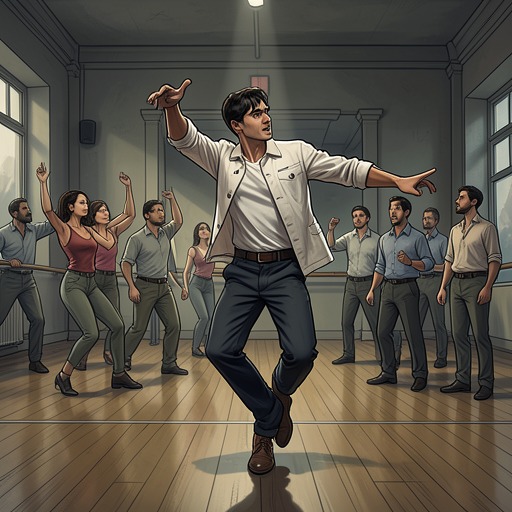
BTS performed No More Dream on the weekly music program M Countdown after rehearsing its choreography for almost two months. The performance was synchronized, but it did not have the seamless polish associated with the most technically controlled forms of K-pop group dance. Its bounces and shimmies answered the lyrics with a rough, urgent physicality, allowing the members’ separate energies to remain visible inside the formation.
The most striking passage came when Jimin, supported by Jungkook, ran across the backs of the other five members. The movement made the performance feel precarious and bodily rather than mechanically exact. In this respect, the choreography differed from the highly standardized kalgunmu associated with groups such as Infinite. Its synchronization did not erase individuality; it depended on the members’ distinct force and timing to connect with the audience. The performance thus embodied the song’s larger claim: discipline could be used to express rebellion rather than conformity.
Industry and Cultural Significance
No More Dream introduced BTS as underdogs in an industry organized around hierarchy, prestige, and rapid judgments of status. Big Hit Entertainment was younger and less connected than the dominant companies, and the group had to establish itself while surrounded by Seoul’s cultural and commercial elites. The song’s very lack of polish exposed that disadvantage, but it also gave BTS a recognizable position. The members were not presented as unreachable models of perfection; they were framed as young people speaking about the pressures shared by their peers.
That approach challenged the image of K-pop idols as manufactured figures whose role was to sell dreams and provide escape. Western commentary often treated K-pop performers as interchangeable products, reinforcing the idea that Asian artists lacked the individuality valued by Western pop culture. No More Dream answered that assumption by foregrounding personal and generational experience. Its authenticity was not a claim that BTS stood outside the idol system; the group remained produced, trained, styled, and promoted within it. Rather, the song made the system’s resources serve a message about the lives of people constrained by it.
The debut also set the foundation for BTS’s later relationship with its international audience. The group’s mission was to speak about ordinary matters affecting people of the same age—friendship, difficulty, ambition, and uncertainty—rather than maintain the distance of an unreachable idol. As BTS later became a national cultural representative and a global act, that early commitment continued to shape how its public identity was understood. The scale of the group’s later success, including its economic contribution to South Korea and the worldwide activity of ARMY, transformed the meaning of the debut in retrospect: the song that once announced a poorly resourced outsider became the opening statement of a global career.
Legacy of the Debut
No More Dream remains decisive because it gave BTS a problem to pursue before the group had the status to solve it. It opposed a society that demanded prescribed achievement, an industry dominated by entrenched companies, and an international pop culture inclined to dismiss Asian performers as manufactured or insufficiently individual. The song’s youthful anger, incomplete polish, and insistence on hip-hop credibility formed a coherent beginning.
Its enduring significance is therefore less a matter of technical perfection than of direction. BTS began by asking young people to recover the capacity to want something for themselves. That question became the group’s first durable bond with its audience and the earliest expression of the underdog identity that would remain attached to BTS even after extraordinary commercial, cultural, and national recognition.